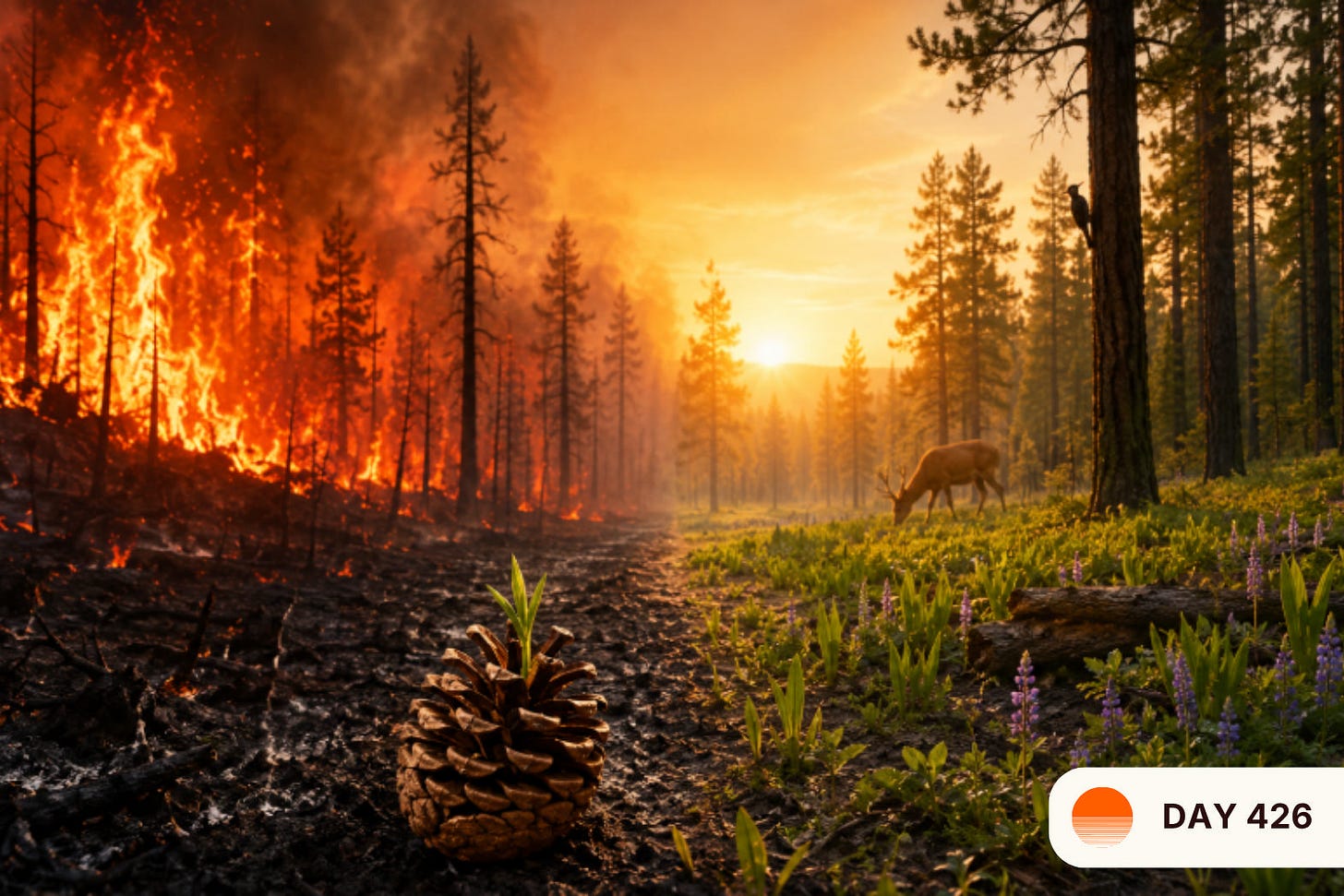
Here’s something that sounds backwards: some trees can’t reproduce without being set on fire.
Lodgepole and jack pine seal their seeds inside cones coated in resin so thick that only real heat — flame, not sun — can melt it open. The tree spends its whole life carrying its future locked in a fireproof vault, waiting for the one event that looks like destruction to everyone watching, but is actually the key turning in the lock.
That’s the part of forest fires most people never learn: it is a natural occurrence for the understory of a forest to burn. Low, slow fires move through the underbrush every 5 to 20 years in many dry forests, clearing out dead leaves, needles, and crowded saplings before they pile up into something more dangerous. Ecologists call this a fire regime — a rhythm the forest is built around, the same way a body is built around a heartbeat. When it happens on schedule, it isn’t a crisis. It’s maintenance. New grasses come in within weeks. Elk and deer follow the fresh growth. Species that depend on burned ground — certain woodpeckers, certain wildflowers — get the habitat they need to survive. It actually brings hope through renewal.
Yet at this moment, hundreds of wildfires are burning across the world — more than 700 active in Canada alone, alongside major fires in the United States (Louisiana, Arizona, Wyoming, Florida), Spain, France, Greece, Portugal, Italy, Turkey, and Chile. And they are causing great damage to both the landscape and humanity — far more than the natural process would ever cause on its own.
This isn’t really a story about nature turning against us. Researchers estimate that roughly 84% of wildfires are started by people — unattended campfires, burning debris, faulty equipment, arson — and that human-caused fires now stretch the natural fire season by more than 100 days a year. Add in the hotter, drier conditions climate change is producing, and you get fires that move faster, burn hotter, and hit forests that never got their scheduled, low-intensity burn to keep them in balance. Most of what’s burning right now isn’t the forest doing what it’s built to do. It’s us, changing the rules the forest evolved around.
So this is a different kind of hope than the one growing quietly in a fire-adapted pine forest. It’s the hope that we can tell the difference — between the burn that renews and the burn that only destroys — and act accordingly: contain what’s raging now, protect the people and animals in its path, and get better at letting controlled, natural fire do its slow, patient work before the fuel builds up into something we can’t stop.
Question
What’s the last thing you saw — in nature or in people — that looked like it was falling apart but was actually just clearing space for something new? Drop it in the comments below.
A song written entirely around the idea of rising out of what’s burned down.
A Daily Dose of Hope — one short reflection each day about where hope lives in our world. Read in 50 states in the US and 94 countries throughout the World.