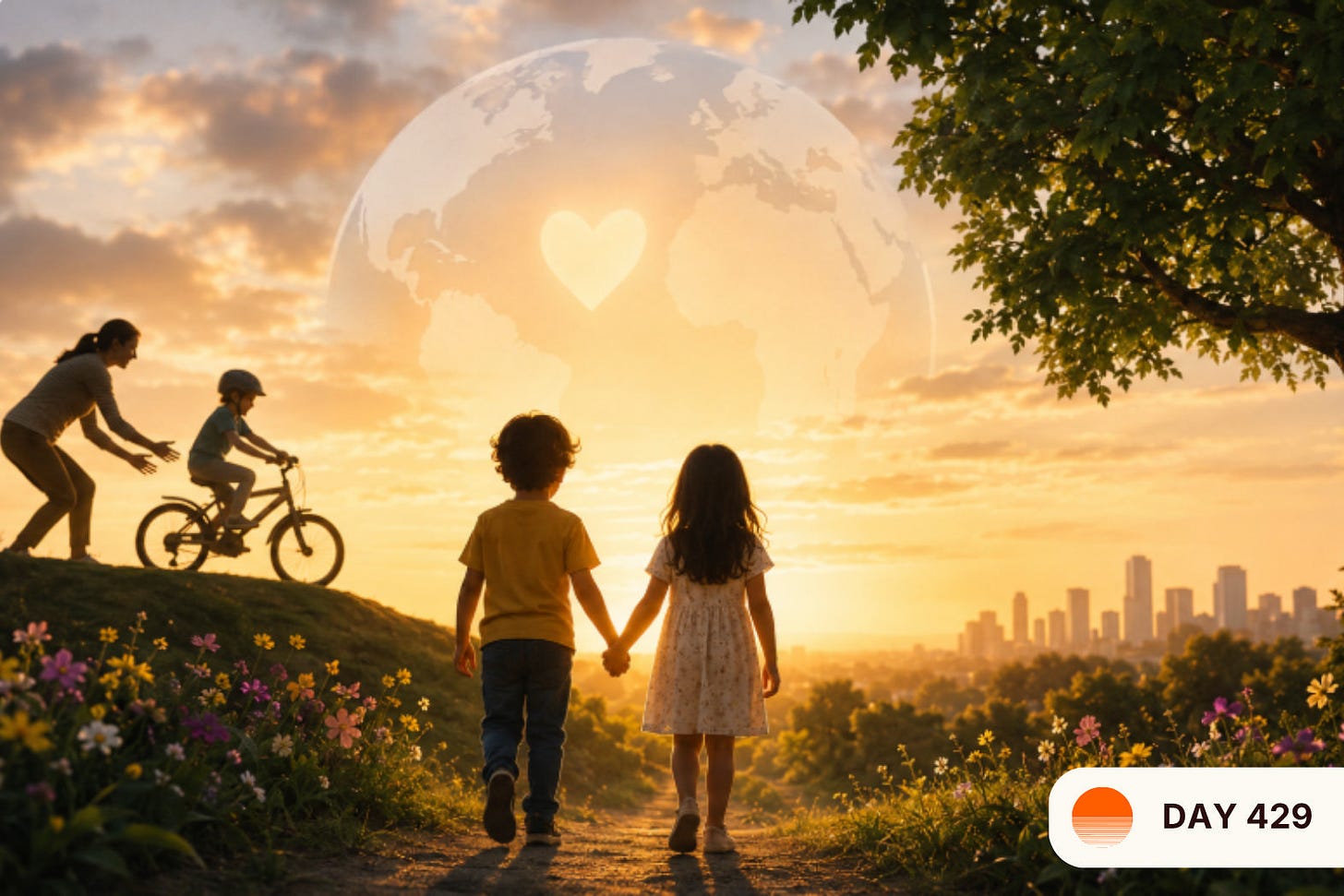
Today, I want to share two different forms of hope that involve children — one about how children give us hope, and the other about how we hope for the best possible future for them.
______________________________________________________
Recently, I started reading 1440 Daily Digest and realize it strips out opinion, sensationalism, and clickbait, presenting concise summaries gathered from a wide spectrum of mainstream sources. I hope you enjoy it.
______________________________________________________
How Children Give Hope
The first comes from one of the newest members of our hopeful community, who wrote:
“Children give me hope. After 10 years as a preschool teacher, I realized that as every child forges their own path, they create their future — each one different, each one worthy. Together these children, these paths, these futures could do so many things.
So when I watch children play and interact, I feel hope. I feel honoured to have been a tiny part of their path, their growth, their future.”
How We Hope for Our Children
On March 21, I wrote a post called “Hope for our Children.” Since so many of you are new to the Daily Dose of Hope, I felt it was worth revisiting the highlights here.
We had recently learned that my wife’s car didn’t need minor repairs but was declared to be totaled by the insurance company. Consequently, we found ourselves in a car showroom.
And, of course I couldn’t resist telling the account executive about the Daily Dose of Hope. Like so many people do, he immediately understood the premise — hope belongs to everyone. It crosses borders, beliefs, incomes, professions, and languages.
So I asked him: What gives you hope?
His answer came instantly: “My children.” He hopes they’ll have a future marked by peace, prosperity, growth, and health.
What gives us hope for our children isn’t that we know exactly what their lives will look like because we don’t and we can’t. We never have. What gives us hope is something deeper: we want them to be safe enough to grow and healthy enough to thrive; loved enough to become fully themselves; and, free enough to build lives larger than our fears.
Hope looks different in different cultures. In one place it is education. In another, stability. In another, kindness, faith, or freedom. Yet, beneath all of it is the same fundamental hope: may those who come after us live well.
Hope for our children doesn’t depend on an easy forecast. Recent research from Pew found that across the countries it surveyed, a median of 57% of people believe children in their country will be financially worse off than their parents. And yet parents and grandparents still get up every morning and do what love requires — they teach, save, encourage, protect, sacrifice, and begin again.
Why? Hope and optimism aren’t the same thing. Optimism says, “Things will probably work out.” Hope says, “Even if the road is uncertain, I will still plant something for the future.” That, to me, is one of the bravest things human beings do.
Research on parenting values across cultures shows that societies differ in what they emphasize. Yet, some hopes keep reappearing: responsibility, respect for others, care, and the qualities that let a child live meaningfully with other people. The World Values Survey is one of the largest international social surveys; it spans 120 countries. It shows that cross-cultural research finds shared values — politeness, responsibility, care — showing up across very different settings.
Parents around the world may not agree on everything, but they often agree on what matters most: they want their children to have a life with enough dignity, health, opportunity, and human connection to make growth possible.
Hope for our children is one of humanity’s most universal languages
I believe that’s because children carry something extraordinary for all of us — not just our genes or our family names — but our unfinished prayers for the world.
Parents don’t hope because the future is certain. Parents hope because love refuses to stop at the edge of uncertainty.
Question
What is the one thing you hope every child in the world gets to experience — and why that one thing? Place it in the chat below.
A Daily Dose of Hope — one short reflection each day about where hope lives in our world. Read in 50 states in the US and 96 countries throughout the World.