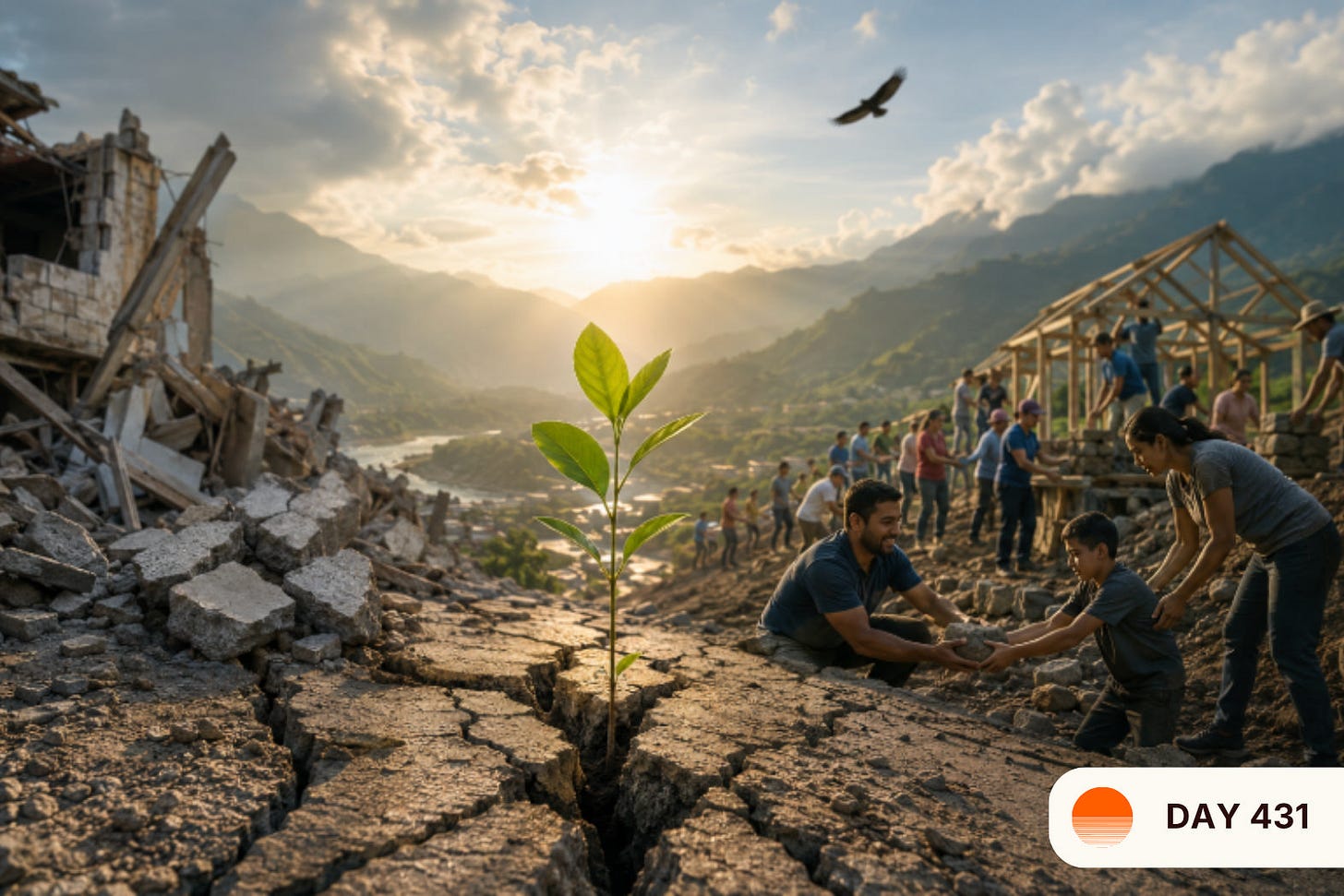
A new member of our hopeful community recently answered my question — “what gives you hope?” — with this: “Nature. Everything has its place and purpose.”
With the news from Columbia, I reflected on this statement. If everything has its place and purpose, what could be the hopefulness as a result of an earthquake?
__________________________________________________
Recently, I started reading 1440 Daily Digest and realize it strips out opinion, sensationalism, and clickbait, presenting concise summaries gathered from a wide spectrum of mainstream sources. I hope you enjoy it.
By way of background, on August 10, 2026, a magnitude 7.4 earthquake struck near San José del Palmar in Chocó Department; it was the strongest quake to ever hit the country since we started keeping records in the 1920s. Many cities—including Cali, Manizales, Pereira, and Quibdó—were shaken. As of this writing, over 132 people died, hundreds more were injured, and more than 1,500 homes were damaged or destroyed.
An Earthquake’s loss is real so how does it bring hope?
Earthquakes are part of why Earth is habitable at all
Plate tectonics recycles carbon between the crust and atmosphere over geologic time, which is part of what’s kept the planet’s climate stable enough for life across billions of years. Mars doesn’t have this. A geologically “dead” planet is also, not coincidentally, a lifeless one. So the same restlessness that causes quakes is tangled up with the reason there’s anything here to grieve over in the first place.
The track record of cities
San Francisco, Lisbon, Tokyo, Christchurch — all leveled by major quakes, all rebuilt into places people now choose to live. That’s not a guarantee Chocó follows the same arc, but it’s real precedent that devastation isn’t the end of a place’s story.
Disasters tend to force real improvements that save lives later
Building codes, early-warning systems, and emergency response all get sharper after major quakes, often because of the ones that came before. Japan’s warning systems exist because of past earthquakes, not despite them. So part of the hope is forward-looking: this one will make the next one less deadly somewhere else.
The International Response
Aid, rescue teams, and money moving toward Chocó from countries with no obligation to send any of it. It’s easy to miss because it’s less dramatic than the disaster, but a wave of strangers deciding to help is happening right now, mostly out of frame. (I donated to the Colombia Se Levanta: Earthquake Relief 2026 immediately)
Appreciation of Life
Survivors of major disasters often report what the psychological research calls “appreciation of life” — a lasting shift in what they value once they’ve had a close look at how fragile things are. Not everyone gets this, and it’s not worth the cost of getting it. But it’s a real and common outcome.
An earthquake can crack the ground, but it has never once cracked hope out of a community that's decided to rebuild.
Question
Have you ever gone through your own personal “earthquake” — something sudden, unwanted, completely out of your control — that ended up clearing space for something you couldn’t have built any other way?
A Daily Dose of Hope — one short reflection each day about where hope lives in our world. Read in 50 states in the US and 96 countries throughout the World.