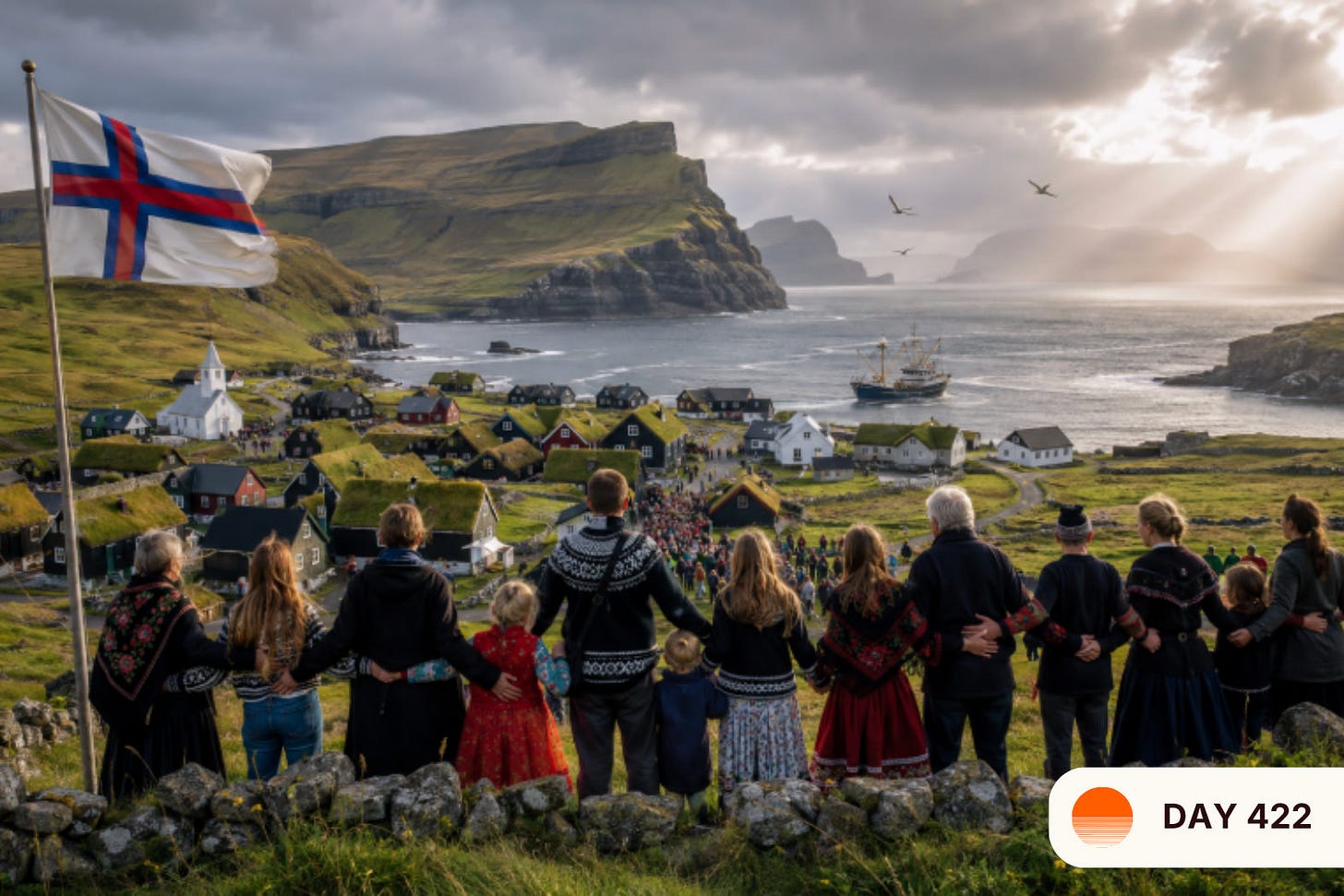
In 2020, while most of the world was quietly falling apart, one place got measurably better. Researchers comparing pre- and post-lockdown surveys in the Faroe Islands found that people reported better self-rated health, better quality of life, and higher levels of physical, mental, and spiritual well being during COVID than before it. Not despite the isolation. Somehow, because of how they moved through it.
If you’ve been reading the Daily Dose of Hope for a while, you know what I’ve been up to: instead of guessing what hope looks like for the members of this community scattered across 91 countries, on occasion I’ve been going country by country and quietly digging in — nothing invasive, no DMs, no surveys, just research, reporting, and the words of people who actually live there. This week I landed on the Faroe Islands (they're a self-governing nation within the Kingdom of Denmark)—18 wind-scraped islands between Iceland and Norway that I’ve wanted to visit for years.
Here’s what I found:
There are only about 54,000 people in the entire country, and most of them live in villages small enough that you know your neighbor’s whole family, not just their name. That’s not a quaint detail — researchers who study wellbeing point to exactly this kind of density of relationship as one of the strongest predictors of resilience there is. When something goes wrong, you are never actually alone with it. Someone already knows.
Then there’s the sea. Fishing has shaped Faroese life for over a thousand years, and it still does — it’s not nostalgia, it’s the economy and the identity at once. There’s something in that relationship with the ocean, the weather, the unpredictability of it, that seems to build a different kind of patience in people. You can’t out-plan the sea. You can only learn to work with it. I think that’s part of why the pandemic didn’t break something here the way it did elsewhere — this is a culture that has been practicing “we don’t control this, and we’ll be okay anyway” for centuries.
Culture holds the rest together. Faroese is spoken by roughly 50,000 people on Earth, full stop, and yet it survived Danish rule, forced schooling in another language, and every pressure a tiny nation faces to just fold into a bigger one. It didn’t fold. Neither did the old chain dances, the sagas, or the ólavsøka festival every July, where basically the whole country shows up.
Hope, it turns out, isn’t only a feeling. Sometimes it’s just a language that refused to disappear.
And then there’s the quieter thread: self-determination. Denmark still handles a few things, but the Faroe Islands have spent decades steadily building their own path — undersea tunnels stitching once-cut-off islands together, an economy widening past fish into salmon farming, tourism, and tech, more autonomy every decade rather than less. That’s a very specific kind of hope: not “it’ll work out,” but “we’re building the thing that makes it work out.” Faith factors in too — church attendance here runs unusually high for the Nordic region, and for a lot of Faroese people, that’s not background noise. It’s the whole foundation.
I don’t think the Faroe Islands are hopeful despite being small, remote, and hard to get to. I think they’re hopefulbecause of it. Smallness forces you to actually know people. Remoteness forces you to actually rely on them. We keep chasing scale as if it’s the answer to everything, and then a nation of 54,000 people on rocks in the North Atlantic quietly outperforms us on the thing we say we want most.
Hope isn’t only found at destinations. Hope is often found in the middle — in this case, in the middle of the North Atlantic, in a country most people couldn’t point to on a map.
Written in 1906 during a period when the islands were genuinely divided over whether to hold onto the old ways or push for more independence. It’s not a battle cry. It’s a quiet, aching love letter to the land itself, asking simply for it to be blessed and cared for.
Question
What’s one thing your home country does — big or small, old-fashioned or strange to outsiders — that you think quietly keeps hope alive there? Not the postcard answer. The real one, the thing you’d only know if you’d actually lived it.
A Daily Dose of Hope — one short reflection each day about where hope lives in our world. Read in 50 states in the US and 91 countries throughout the World.