_________________________________
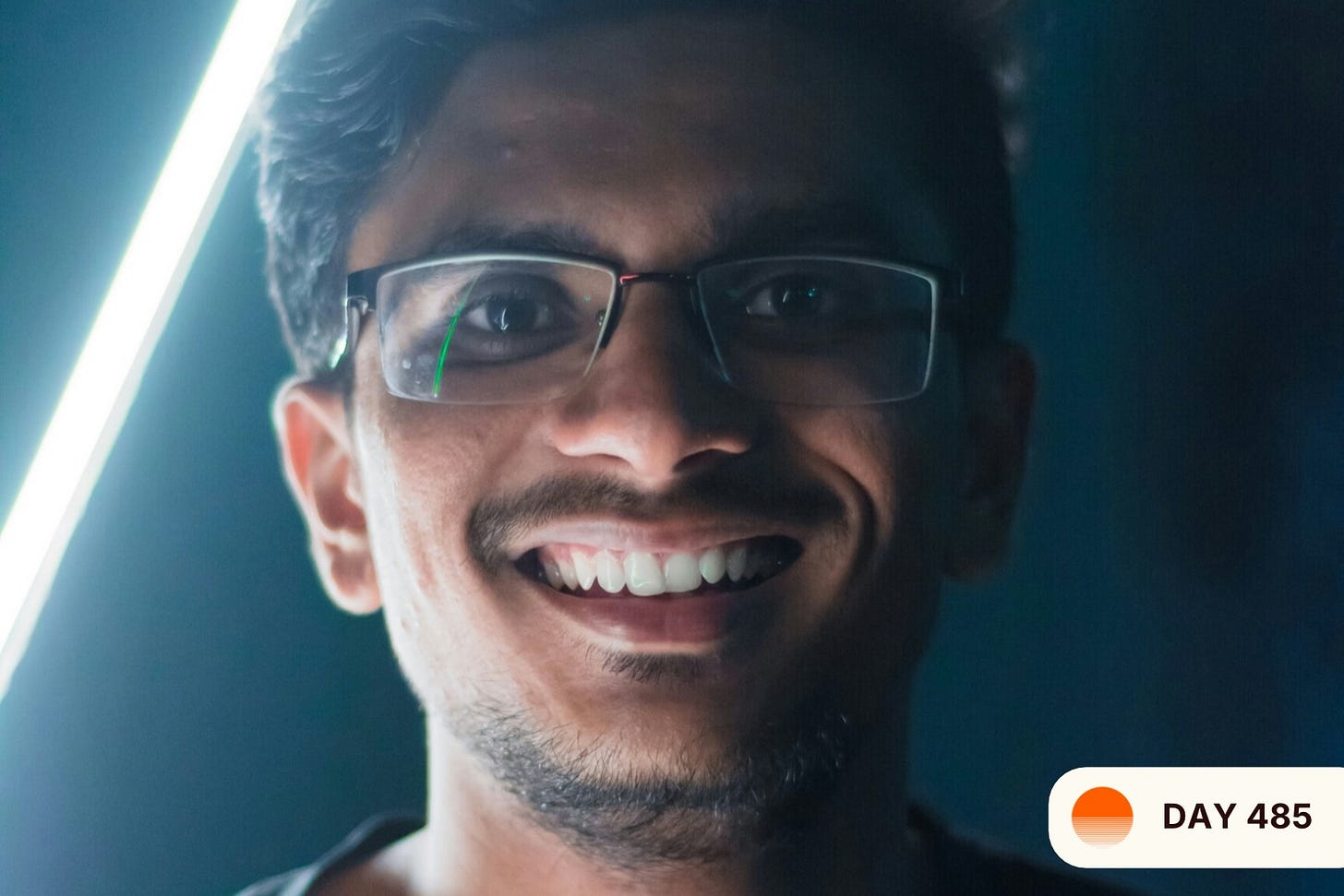
Today's Daily Dose of Hope is sponsored by Superhuman AI, the daily newsletter that helps you learn AI in about three minutes a day. Like the DDH, it's a small daily habit, and it keeps you curious and a little more ready for what's coming. If you want to see how these tools can make your work easier, look below.Put on a pair of glasses after a long stretch without them and watch what your face does. The squint lets go. Your head tilts back a little. Something that was a smear a second ago turns into a leaf, a street sign, or someone’s eyes.
_________________________________
That moment is the entire post.
Hope starts in a lot of places, but one of the most dependable is the instant the world comes into focus. A world you can see is a world you can step into.
There are three kinds of hope related to eye glasses, each tied to a real study or a real person and every one of them riding on a few ounces of glass and plastic.
Three Kinds of Hope You Get Because You Can See
Hope for a child’s future
In Gansu province in western China, researchers ran a randomized trial across 165 schools and more than 19,000 students. Some schools gave free eyeglasses to kids who needed them while others didn’t. After one year, test scores in the glasses group were up by 0.15 to 0.30 standard deviations1.
In other words, a child who couldn’t read the blackboard could now read the blackboard. The researchers note that roughly 10% of primary school students in developing countries have poor vision that needs correcting. Ten kids out of a hundred are quietly falling behind for a reason that has nothing to do with how smart they are. Glasses give a child the one thing that make schools run: a chance to keep up.
Hope for a livelihood
In Assam, India, a trial called PROSPER gave $1.80 reading glasses to 750 tea pickers, mostly women, whose near vision had faded. Over three months, their productivity rose 22%. For workers who were over 50, productivity rose 32%. They picked more than five extra kilos of tea a day2.
Think about that one: a woman in her late 40s starts to feel herself slowing down and assumes it’s age. Then a pair of glasses that costs less than a cup of coffee in many cities hands her the speed back as well as the paycheck she deserved. The lead researcher, Nathan Congdon, said the study showed that even tasks that don’t seem obviously visual can be boosted “so impressively by glasses.”
Hope for the next chapter
On May 23, 1785, Benjamin Franklin sketched a new kind of spectacle in a letter to his friend George Whatley. Franklin was 79 at the time and credited with the design of the first bifocals. As a result, when he found himself at dinner in France, Franklin could see his food and his companions’ faces immediately, which, in turn, helped him to follow what was being said. His verdict: “I understand French better by the help of my Spectacles3.”
So Benjamin Franklin gave himself a new seat at the dinner table. This action demonstrates the third kind of hope: the belief that your next chapter still has conversations in it, and that you’ll be able to follow them.
The Part That Isn’t Tidy
There is a catch, though. The World Health Organization says at least 2.2 billion people have a near or distance vision impairment. About a billion of those cases are preventable or still unaddressed (I’m headed to the eye doctor this week, myself, from writing too many editions of the Daily Dose of Hope methinks).
Two out of three people in low income countries who need eyeglasses don’t have access to them (did I tell you about my college roommate’s brother-in-law who was an ophthalmologist in many countries in Africa attempting to remedy that issue?) Presbyopia, the age-related loss of near vision, accounts for 826 million of the unaddressed cases. The WHO puts the global productivity loss at about $411 billion a year, against roughly $25 billion to address the need 4 .
The conclusion? Hope is real and so is the gap. The tea pickers in Assam got their glasses because somebody ran a trial and someone paid for it. Plenty of people haven’t had that luck. I don’t have a simple way to close that gap. What I do know is that the fix is small enough to hold in one hand.
Hope comes into focus. For so many people on this planet, it’s still waiting at the optometrist’s door.
Hope sees the invisible, feels the intangible, and achieves the impossible.
Question
Think about the first time you put on glasses, or the first time you watched someone you love put theirs on. What was the first thing you saw clearly that you hadn’t realized you were missing?
A Daily Dose of Hope — one short reflection each day about where hope lives in our world. Read in 50 states in the US and 155 countries of the 195 countries throughout the World.
Attributions
1 Eyeglasses and academic performance, randomized trial in Gansu, China (working paper summary)
2 Orbis: Glasses study shows huge productivity boost for workers (PROSPER, Assam, India)
3 Library of Congress: Benjamin Franklin, Scientist and Inventor
4 World Health Organization: Vision impairment and blindness