____________________________________________
Today's Daily Dose of Hope is sponsored by 1440, the free daily newsletter for the insatiably curious. In about five minutes each morning, it gives you a fact-driven rundown of the day's news from 100+ sources, without the clickbait. If you believe, as I do, that hope grows best on a foundation of clear eyes and good information, give it a try.
____________________________________________
As you may remember—for those of you reading the Daily Dose of Hope on Substack—on March 24, 2026 (Day 287 of the DDH), I wrote a post entitled “Why Hope Sometimes Shows Up As Anxiety.” I wrote:
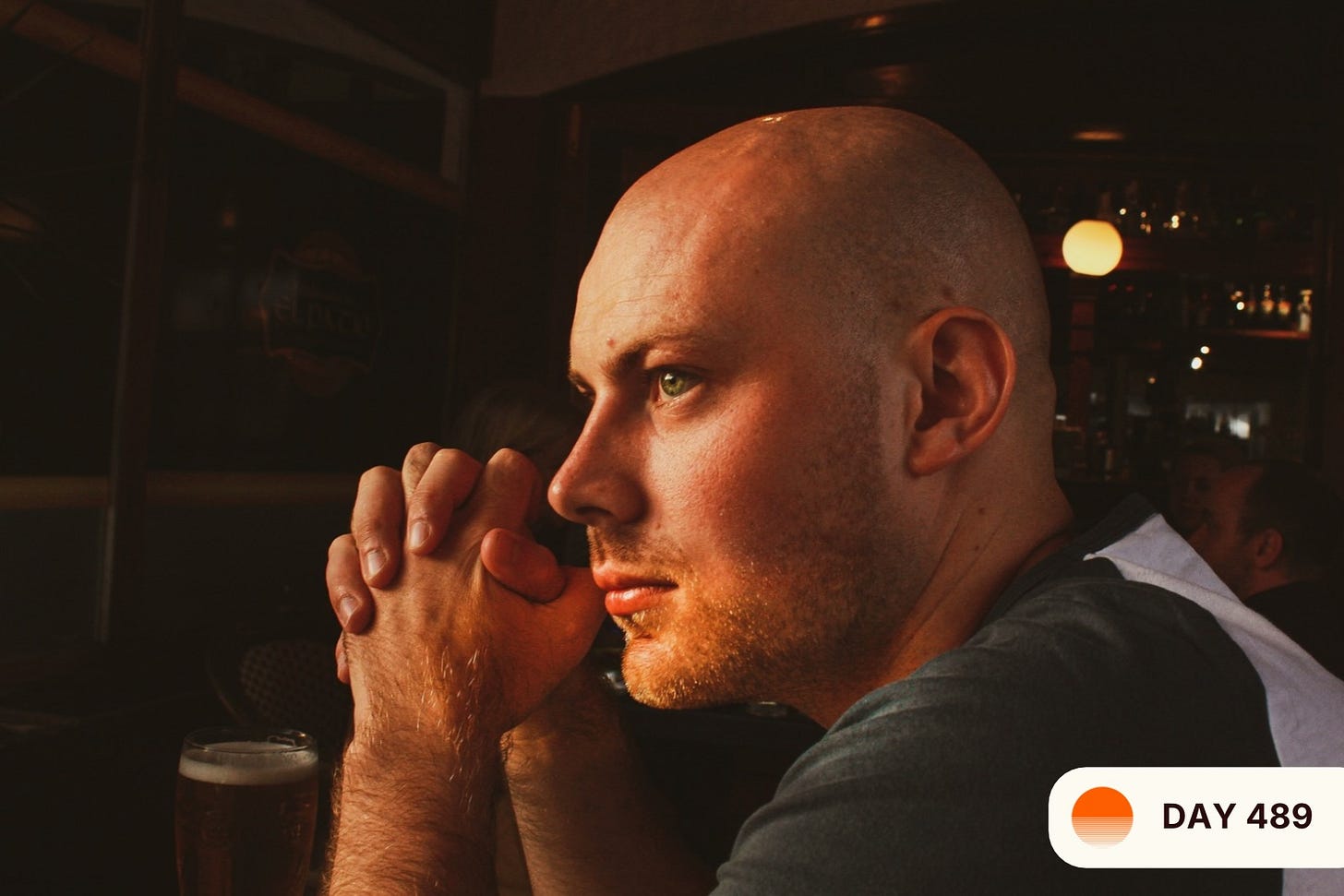
“As many of you know now, I’m bald and proud of it. But being bald also means my scalp has had years of direct sunlight. Even though I wear hats and put sunscreen on, my dermatologists have told me for some time that I should treat the actinic keratosis, or AK, on my scalp. AK is a common rough, scaly patch caused by long-term UV exposure. Dermatologists treat it seriously because some AKs can progress to squamous cell carcinoma, and there is no reliable way to know which ones will and which ones won’t.”
At the time, I underwent a procedure called photodynamic therapy—the application of a light-sensitive solution to the skin, followed by exposure to a special light. The procedure made me both anxious and hopeful, as I described in that post. Through the experience, I learned that these two seemingly opposing feelings (anxiety and hopefulness) could motivate me to learn more about what I was facing. Once the procedure was complete, I felt optimistic.
Well, almost seven months later, I went back to my dermatologist, who did a full skin examination to make sure everything looked okay. I asked him to pay particular attention to one spot on my scalp that concerned me.
He looked at it and said it needed to be biopsied.
My immediate thought was “Why?”—which I promptly blurted out.
He said he suspected squamous cell carcinoma, but he wasn’t sure. That was why the biopsy was necessary.
Unlike the photodynamic therapy in March, this time I had a pretty good idea of what would happen: he would numb the area and then take a sample—which he did.
I wasn’t anxious. My reaction was simply, “Geez, I really hope this isn’t squamous cell carcinoma.”
Of course, as I had done in March, I peppered him with questions. During our conversation, I learned that he, who is fair-skinned, had actually had squamous cell carcinoma himself. He was completely fine, and he reassured me that, if my spot proved cancerous, he expected that I would do well, too.
None of this conversation was making me happy, but it wasn’t making me anxious either. I was hopeful that everything was okay. Still, when I returned home, I decided to do some research.
And here is what I learned.
Squamous cell carcinoma of the skin, or SCC, is a cancer involving squamous cells in the skin’s outer layer. It is the second most common form of skin cancer, with approximately 1.8 million cases diagnosed in the United States each year. Long-term exposure to ultraviolet radiation is a major cause.
The encouraging part is that most SCCs are curable when caught early. Treatment commonly involves removing the cancer surgically, sometimes with Mohs surgery, which removes and examines thin layers of tissue until no cancer remains. The appropriate treatment depends on the cancer’s size, location, and other characteristics.
That doesn’t mean SCC should be dismissed: some tumors can grow deeper or spread. And a suspicious spot is not yet a diagnosis—the biopsy is what determines whether it is cancer. So there is reason for hope, but not a reason to assume the answer before the results arrive.3
That distinction matters to me. I can take this seriously without deciding that the worst has already happened. I can be encouraged by what I’ve learned without pretending that I know my own result.
In March, hope showed up alongside anxiety. This time, it seems to have shown up more quietly—as questions, information, and a willingness to wait without jumping to conclusions.
And so now, I sit and wait, hopefully, for the results of the biopsy.
Hope hasn’t given me an answer. But it is keeping me company while I wait.
Breaking news: The results came back: “Scalp, Frontal Mid - Actinic Keratosis-Hypertrophic Type." Great news! It wasn’t squamous cell carcinoma.
Hope is not knowing that everything will be okay; it is leaving room for a good outcome while taking the next necessary step.
Questions
When you’re waiting for an important answer, what helps you stay hopeful without assuming the outcome?
A Daily Dose of Hope — one short reflection each day about where hope lives in our world. Read in 50 states in the US and 155 countries of the 195 countries throughout the World.
Attributions
American Cancer Society – About Basal and Squamous Cell Skin Cancer
Skin Cancer Foundation – Actinic Keratosis
Skin Cancer Foundation – Squamous Cell Carcinoma