____________________________________________
Today's Daily Dose of Hope is sponsored by 1440, the free daily newsletter for the insatiably curious. In about five minutes each morning, it gives you a fact-driven rundown of the day's news from 100+ sources, without the clickbait. If you believe, as I do, that hope grows best on a foundation of clear eyes and good information, give it a try.
____________________________________________
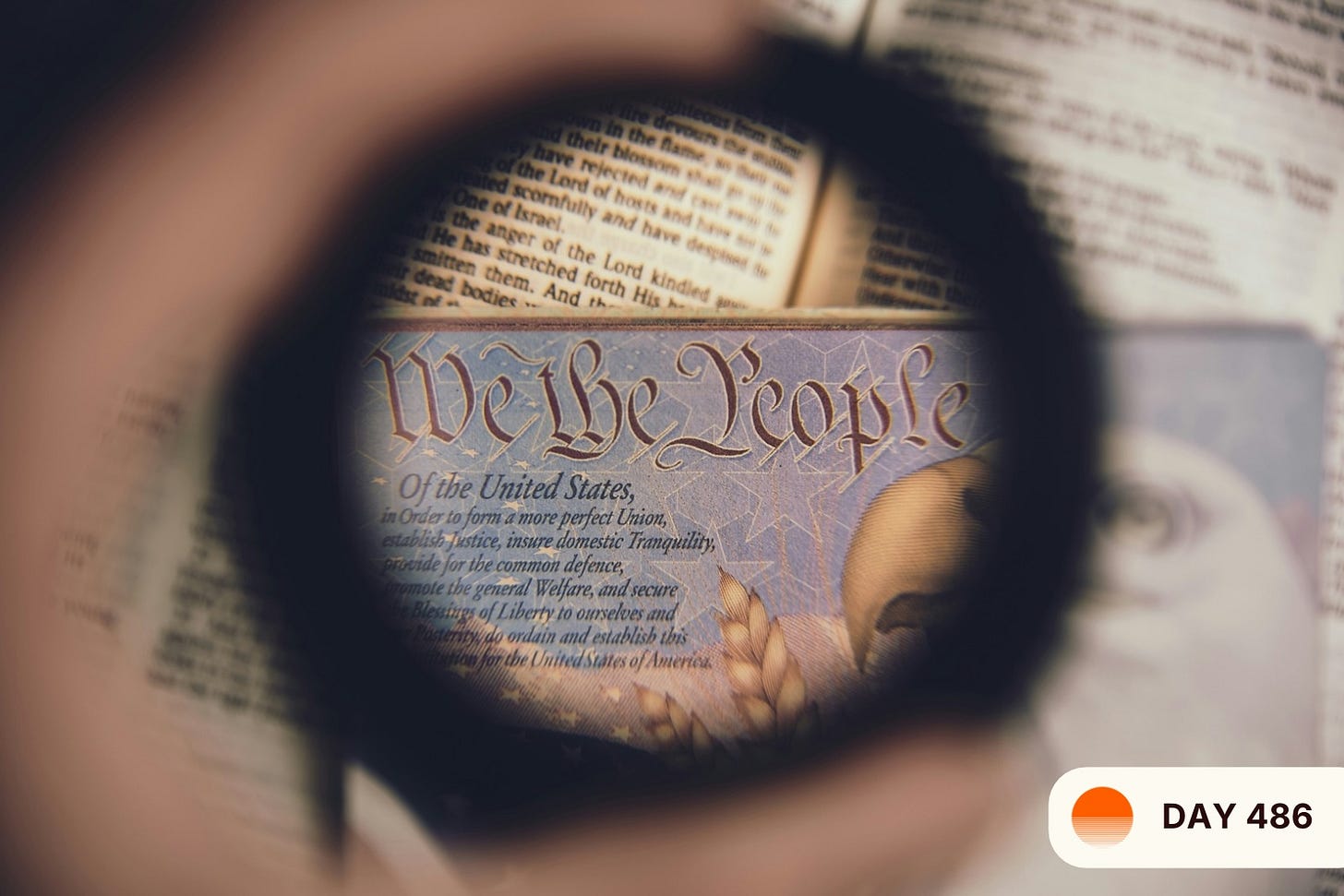
I was speaking with a friend of mine the other day who shared an astonishing set of facts with me.... Someone ran the U.S. Constitution through an AI-content detector, and the detector said it was about 92% AI-generated1. The Declaration of Independence got it worse. One tool called it 99.99% AI-written2, and ZeroGPT flagged the 1836 Texas Declaration of Independence at nearly 90%3.
The reason is crazy. These detectors mostly measure how predictable wording is in a given document. Since the founding documents of the United States are some of the most copied, quoted and memorized sentences in English, they saturate the material from which AI models learn. When these tool see familiar phrasing, they decides that a machine wrote it.
So, as I am predictably wont to do, I asked the question, it real hope just buried here?
Hope lives in the words we’ve all carried
A AI detector reads “predictable” as “artificial.” I interpret these words as “loved.” Sentences can feel familiar when generations of people read them aloud, memorize them, argue over them and taught them to their kids. When a machine can’t tell your words from its own, it may only mean a lot of people have been using those words for a very long time. Good human writing gets absorbed into everyone’s bloodstream, and that’s something for which to hope.
Hope shows up when the tools admit their limits
OpenAI built its own AI-text detector and then shut it down in July 20234 because of its low accuracy. By the company’s own numbers, it caught only about a quarter of AI-written text. Stanford researchers found something sadder. Detectors wrongly flagged more than half of essays by non-native English speakers5 as AI-generated. Real people, writing real words, were being doubted by a machine. The encouraging part is that the flaws were found, published and argued upon in the open. The people building these tools are checking their own work. For the rest of us, it’s a reminder to extend the benefit of the doubt before a software score does the judging.
Hope is built into a document written by people who disagreed
Fifty-five delegates spent the summer of 1787 in a hot Philadelphia room. They fought, bargained and compromised. In the end, 39 of them signed6 a document. Gouverneur Morris polished much of the final language, including that famous opening, “We the People.” They also knew they’d gotten things wrong, so they built in a way to fix them. So far, this document has been amended 27 times. A document written by flawed, arguing humans can be repaired by flawed, arguing humans. No detector can score that kind of hope.
A machine looked at the words that founded a nation and decided no person could have written them. A room full of sweating, stubborn, imperfect people actually did.
Your voice doesn’t have to be unusual to be yours. Say the true thing plainly, and trust that it’s still human. That trust is where hope starts.
It’s about the closed-door arguing and bargaining that shaped the country, which is exactly the human part the detector couldn’t see.
Question
What’s one sentence someone once wrote or said to you that you’ve never forgotten, and what hope did it make possible?
A Daily Dose of Hope — one short reflection each day about where hope lives in our world. Read in 50 states in the US and 155 countries of the 195 countries throughout the World.
Attributions
1 The US Constitution was written by AI, apparently – The Short Cut
2 AI Detector Calls The 1776 Declaration ‘99.99% AI-Written’ – MSN
3 ZeroGPT Flags 1836 Texas Declaration Of Independence As Nearly 90% AI-Generated – Dallas Express
4 OpenAI scuttles AI-written text detector over low rate of accuracy – TechCrunch
5 AI detectors have a bias against non-native English speakers – Advanced Science News
6 U.S. Constitution FAQs – National Constitution Center