_______________________________
Today's Daily Dose of Hope is sponsored by Morning Brew, the free daily newsletter that covers business news, from Wall Street to Silicon Valley, with a little wit...and in about five minutes. Hope and good humor go together, and Morning Brew gives you a smart, lighter start to your day. Sign up below.
_______________________________
The 18,000-Step Day
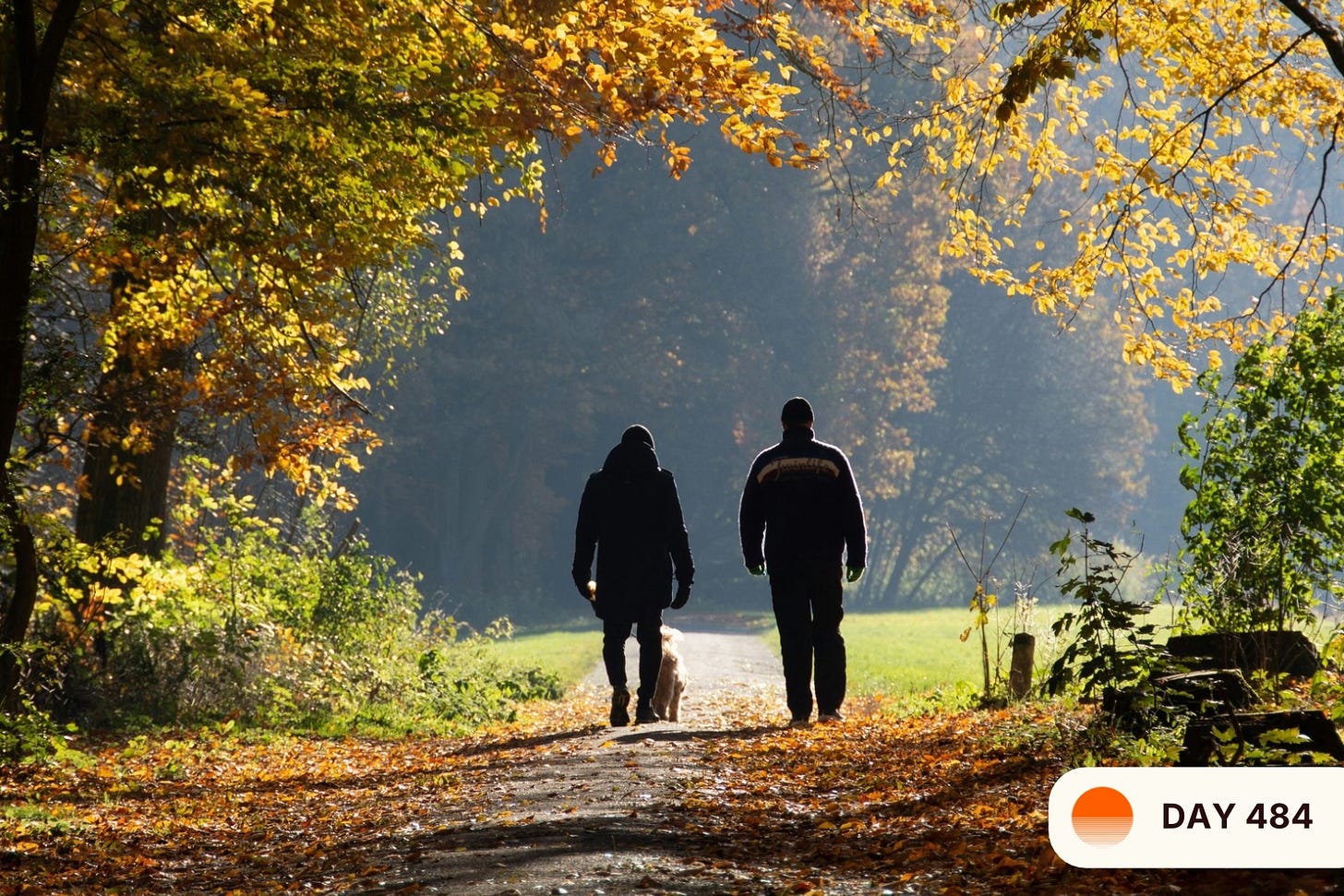
I walked more than 18,000 “steps” in a single day this week. Somewhere around step 12,000, I started wondering what I was actually getting out of it besides tired feet. Then the question surfaced that I always ask, “can walking give you hope?”
My own legs weren’t all that got me asking this question. A friend of mine recently had a knee replaced. When I asked him how he was doing, he wrote back: “Doing well! Lots of hard work on rehab, but every week is a next level. Can walk a couple of miles, ride stationary bike, etc, so all good.”
“Every week is a next level.’ That’s hope in a phrase: hard work today and a better week is ahead.
Thus, I began thinking that walking can give you hope. It does it differently depending on where you stand in life. (Pun intended; apologize.)
Where Does Hope Start: The First Steps
When you watch a toddler take a first step you’re watching hope in motion. The face is extremely telling: wobble, grin, fall, up again.
Karen Adolph, a developmental psychologist at NYU has spent decades studying what happens during early days of a toddler’s life. She found that new walkers take thousands of steps and tumble dozens of times a day. Yet, they keep getting up anyway 1. No one tells a one-year-old that falling is part of the deal. They, therefore, just “go.”
What does walking get them? Adolph’s broader research shows that once babies move on their own, they explore more, reach more, and engage with people and objects in new ways 2. To the extent that a child can get to the things that he/she want, they then have a future to walk toward.
None of us can prove a toddler feels hope in the way that adults do. Yet, there seems to be an expectation that their next try at walking is somewhat baked into each and every step they take.
Grown-Up Steps Give Hope: Exercise and the Lift It Gives Us
As we grow into adulthood, mobility continues to be a source of hope. Exercise is added on top of mobility though. Hope needs energy. And, it requires a mind that believes things can change. Walking fuels both of these dimensions.
The evidence is pretty terrific. A 2024 review of 75 randomized trials with 8,636 participants found that walking reduced symptoms of depression and anxiety compared to doing nothing. The effect was greatest in people who were clinically depressed 3. Walking performed about as well as other forms of exercise. Therefore, all you really need is a pair of shoes to generate hope.
In 2025, a meta-analysis in The Lancet Public Health pooled 57 studies and found that people who walked about 7,000 steps a day had a 47 percent lower risk of dying early and a 38 percent lower risk of dementia than people closer to 2,000 4. Seven thousand, not ten thousand. Seems as if my 18,000 steps was a bonus.
Hope is partly a bet on tomorrow. Walking improves your odds of being there to collect.
For Those Who Can’t Walk: The Hope of Maybe
Whether people have never walked or lost their ability to do so, the thought of walking is its own kind of hope. It’s also now backed by real science.
In 2018, Swiss researchers reported that three men with long-standing spinal cord injuries regained the ability to walk with the help of targeted electrical stimulation of the spinal cord, plus intensive rehab 5. In 2023, a different team described a “brain-spine interface”: implants that read the brain’s walking intentions and pass them wirelessly to a stimulator on the spine. The patient, a 38-year-old man paralyzed ten years earlier in a cycling accident, could stand, walk with crutches, and climb stairs. He even kept some ability to walk even with the device switched off 6.
These are very small studies. And, they aren’t cures. They don’t mean walking is around the corner for everyone. Yet, a door that was closed for generations is now open a crack, and people who live with paralysis are right to feel something stir.
Hope doesn’t have to wait for a guarantee. It only needs a credible “maybe.”
Three More Reasons Walking Gives Us Hope
It frees up ideas
Stanford researchers Marily Oppezzo and Daniel Schwartz found that creative output jumped by an average of 60 percent when people walked rather than sat. Even a treadmill facing a blank wall worked. And, the boost lingered after people sat back down 7 . Hope often arrives as an idea, a way out you hadn’t seen yet. A walk shakes those loose.
It quiets the loop
Gregory Bratman and colleagues at Stanford sent people on a 90-minute walk, some through nature and some along a busy road. The nature walkers reported less rumination, that stuck-in-a-groove replaying of what’s wrong, and showed lower activity in a brain region tied to it 8. Hopelessness lives in that loop. Walking is one way out of it.
It puts us next to other people
A study of 1,991 people in England’s Walking for Health program found that group nature walks were linked to significantly lower depression and less perceived stress, especially for people who’d recently been through something stressful 9. Side-by-side conversation is easier than face-to-face. Ask anyone who’s ever said the hard thing on a walk.
So, Can Walking Give You Hope?
Yes, though not in the same way for everyone. For a toddler it’s the world opening up. For most of us it’s energy, a clearer head, and better odds of a long life. For my friend with the new knee, it’s a scoreboard he can watch climb every week. For someone who can’t walk right now, it’s a door that science is slowly pushing open. And for all of us, it’s a way to get unstuck, one foot after the other.
I’ll admit my 18,000 steps weren’t planned. I just kept going. Maybe that’s the whole lesson: you don’t have to see the destination to take the next step.
Hope is just the next step you haven’t taken yet
Question
When was the last time a walk changed how you felt about something, and where were you walking?
A Daily Dose of Hope — one short reflection each day about where hope lives in our world. Read in 50 states in the US and 155 countries of the 195 countries throughout the World.
Attributions
1Adolph et al., 2012, Psychological Science (toddler steps and falls)
2 Adolph & Robinson, “The road to walking”
3 Xu et al., 2024, walking and depression/anxiety meta-analysis
4 Ding et al., 2025, The Lancet Public Health (daily steps) and ScienceDaily summary
5 Wagner et al., 2018, Nature
6 Lorach et al., 2023, Nature
7 Stanford News, walking and creativity
8 Bratman et al., 2015, PNAS
9 Marselle et al., group nature walks, via University of Michigan